

 There’s a uniquely confusing time in a new skydiver’s life where they may not be at all sure which way to track at breakoff. This may not be due to them being stupid; it could actually be the result of being very WELL coached as a student.
Imagine you are this new skydiver. You’re recently licensed, with all the performance objectives checked off on your proficiency card including tracking. Your instructor always told you to practice tracking across line of flight to avoid other groups’ airspace up or down line of flight, and you have learned this lesson well. You’ve paid attention to which way jump run will be flown on your load–let’s say jump run is to the south just for fun–so you expect to track east or west. You even know the landmarks in all directions at a glance.
But now it’s jump 30, and you’re doing your first 4-way skydive. You know you’re supposed to track away from others to gain separation to deploy your parachutes safely. But there are only two direction options for tracking perpendicular to jump run, and there are four of you. What do you do? Hopefully your coach walked you through this so you aren’t trying to figure it out at 120mph!
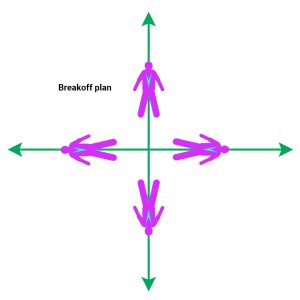
The short answer is that you track 180° from the center of the formation at breakoff altitude, watching for the other members of your group to ensure you have maximum separation from them for your parachute deployment. In this 4-way example, each of you should have your own QUADRANT, not your own HEMISPHERE.
But why have the rules suddenly changed? Does jump run direction no longer matter?
The rules haven’t changed a bit! The key is to understand the WHY behind the rules. Our goal for deployment on every single skydive is to have enough horizontal separation from all other skydivers to ensure we don’t collide on deployment, or shortly thereafter.
What is different now is:
- We’re not practicing tracking for long periods of our skydive; we’re just tracking a bit at breakoff.
- We now have more than two skydivers in our group, and those are the ones (hopefully) closest to us at breakoff and thus the ones we’re most concerned about getting away from. This means that considering jump run direction is now priority 2 after getting away from the people closest to us. Observing proper exit separation between groups should take care of the rest.
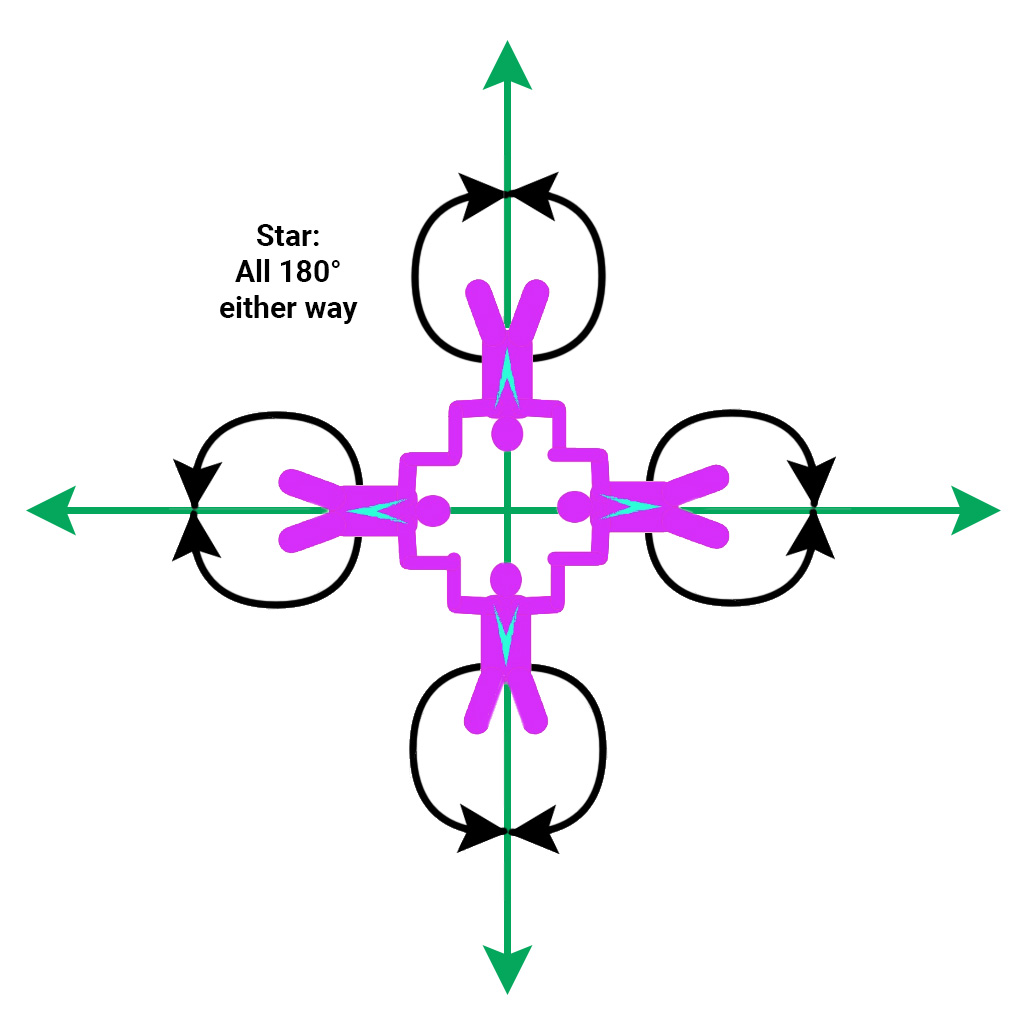
If you’re in a 4way star, turning 180° from the center of the formation should give each of you your own “radial” (similar to a spoke on a wheel) away from the center and equal separation from the jumpers on either side of you. Depending on the formation though, you may need to turn less to hit that same radial. For example, if you’re in a donut formation you may only need to turn about 90° to face away from the center. If you’re already facing outward in a bipole, you won’t need to turn at all. (Rocket launcher ENGAGED!!!)
Break off from a star (click to zoom)
Break off from a donut

Break off from a bipole

Whatever the degree of turn you need to face directly away from the center, make a clean, committed turn that stops on heading before starting your track. That single habit sets the foundation for predictable separation and safer deployments for ALL disciplines. Predictability matters because if you do something crazy, the person next to you may have to do something crazy to avoid you, and they might not see that third person they’re crowding into because of your drama.
Your goals at breakoff:
- Turn as needed to face directly away from the center of the formation.
- Stop your turn before starting to track, especially while you are learning this breakoff skill. This will help you avoid skidding around in an unpredictable path. Your coaches may seem to turn and start disappearing at the same time, but that’s something to work up to with good body control, not a starting point.
- Once you are facing 180° from the center of the formation, track like your life depends on it until your pull altitude, because it does!
But what about jump run? We said it was still priority 2!
It is. If your 180° from center tracking direction puts you directly up or down line of flight, consider not tracking *quite* as hard as you can. You’re going in the right direction to separate from those closest to you (and they should be doing the same), but don’t put yourself into an equally bad situation by blasting into the group in front of or behind you.
It remains true that PRACTICING tracking in straight lines for long periods should absolutely be done across line of flight to avoid encroaching on other groups’ airspace. But when you’re flying with a cohesive group, achieving separation from them is the first priority simply because they’re the closer, more immediate threat.
PS: This article applies to jumps with a straight-down freefall plan, not those with an intentional movement component where breakoffs may be more complex.